Symptoms of Parkinson’s Disease: Recognizing the Early Signs
Parkinson’s disease is a progressive neurological disorder that primarily affects movement, but its symptoms can extend beyond tremors and muscle stiffness. In many people, the condition develops gradually, and the earliest changes may be subtle enough to be mistaken for normal aging, tiredness, stress, or other everyday concerns.
A slight tremor in one hand, smaller handwriting, reduced facial expression, changes in walking, or a diminished sense of smell may appear before more noticeable movement problems develop. Recognizing these changes does not necessarily mean that a person has Parkinson’s disease, as several other conditions can cause similar symptoms. However, persistent or progressively changing symptoms deserve medical attention. Understanding the symptoms of Parkinson’s disease, how the condition typically begins, and its early warning signs can help you know when it may be appropriate to consult a neurologist.
What Are the Symptoms of Parkinson’s Disease?
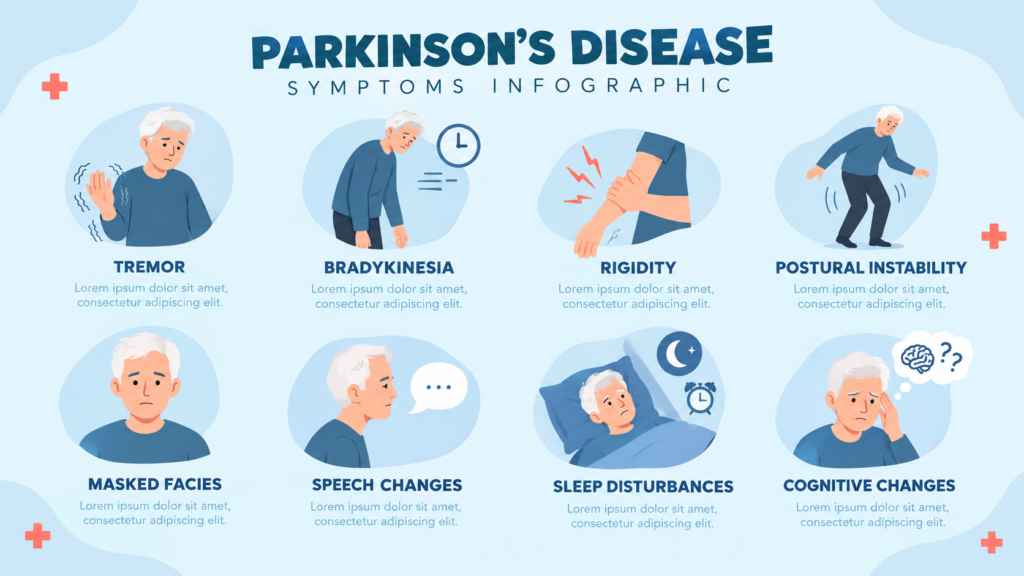
The symptoms of Parkinson’s disease can include movement-related changes such as tremor, stiffness, slowed movements, and balance difficulties, as well as non-motor symptoms such as sleep disturbances, reduced sense of smell, constipation, mood changes, and fatigue. Symptoms vary from person to person and may develop gradually.
Motor Symptoms
Tremor:
A tremor is often one of the most recognizable symptoms. It may begin in one hand, finger, foot, or sometimes the jaw. A Parkinson’s-related tremor commonly occurs when the affected body part is at rest and may become more noticeable during stress or fatigue.
Slowness of movement:
Known medically as bradykinesia, slowed movement can make routine activities take longer. A person may find it increasingly difficult to get up from a chair, dress, shower, walk, or perform tasks requiring fine movements.
Muscle stiffness:
Rigidity can cause muscles to feel tight, stiff, or uncomfortable. It may affect the arms, legs, neck, or other areas and can contribute to reduced movement.
Changes in posture and balance:
Some people develop a stooped posture or experience increasing difficulty maintaining balance. As the condition progresses, balance problems can increase the risk of falls.
Reduced automatic movements:
Parkinson’s disease can affect movements that normally happen without conscious thought. These may include blinking, smiling, facial expressions, and swinging the arms while walking.
Speech changes:
Speech may become softer, slower, faster, or less expressive. Some people may also slur words or hesitate before speaking.
Changes in handwriting:
Handwriting may become unusually small or cramped. This change, known as micrographia, can sometimes appear among the earlier movement-related symptoms.
Non-Motor Symptoms
Parkinson’s disease can also cause symptoms that are not directly related to movement. These may include:
- Reduced sense of smell
- Constipation
- Sleep disturbances
- Acting out dreams during sleep
- Depression or anxiety
- Fatigue or reduced energy
- Changes in thinking or memory
- Increased urinary urgency
- Dizziness or lightheadedness when standing
These symptoms are not specific to Parkinson’s disease and can occur for many other reasons. Their significance depends on the overall pattern and whether other neurological symptoms are also present.
How Does Parkinson’s Disease Start?
Parkinson’s disease generally develops gradually rather than appearing suddenly. In many cases, early symptoms begin on one side of the body and may remain more pronounced on that side even after symptoms eventually affect both sides.
The underlying process involves the gradual loss or dysfunction of nerve cells in a part of the brain involved in movement. These cells produce dopamine, a chemical messenger that helps coordinate smooth and controlled movement. As dopamine-producing neurons are lost, changes in movement and other neurological functions can develop.
The exact reason why these nerve cells become damaged is not fully understood. Genetic and environmental factors may contribute in some people, but Parkinson’s disease does not have a single known cause.
Because the initial changes can be subtle, a person may not immediately recognize them as neurological symptoms. Someone may simply notice that one hand shakes occasionally, walking feels different, movements have become slower, or their handwriting has changed.
Early Signs of Parkinson’s Disease
The early symptoms of Parkinson’s disease can be mild and easy to overlook. They do not occur in exactly the same way in everyone, but some commonly reported early indicators include:
- A slight tremor: A small shaking movement, particularly in one hand or finger while at rest, may be noticed before other movement symptoms.
- Smaller handwriting: Writing may gradually become smaller, more cramped, or harder to control.
- Reduced facial expression: The face may appear less expressive because automatic movements such as blinking and smiling can decrease.
- Softer or altered speech: A person’s voice may become quieter, more monotone, or less clear.
- Reduced sense of smell: A noticeable decline in the ability to smell can sometimes occur before prominent movement symptoms.
- Changes in sleep: Sleep disturbances, including acting out dreams, may occur in some people.
- Slower everyday movements: Routine activities such as dressing, walking, or getting out of a chair may gradually take longer.
- Changes in walking: A person may take shorter steps, move more slowly, or notice that one arm does not swing as naturally while walking.
- Stiffness: Persistent stiffness or reduced flexibility, particularly when it is more noticeable on one side, may be worth discussing with a doctor.
- Changes in posture or balance: Subtle changes in posture or increasing unsteadiness may develop.
Having one of these signs does not mean that a person has Parkinson’s disease. Several neurological, musculoskeletal, medication-related, and other health conditions can produce similar symptoms. What matters is the overall pattern, persistence, and progression of the symptoms.
When to See a Neurologist About Parkinson’s Symptoms
It is worth speaking with a neurologist when symptoms such as tremor, stiffness, slowed movement, changes in handwriting, altered speech, walking difficulties, or unexplained changes in smell persist or progressively become more noticeable.
Early neurological evaluation can help determine whether the symptoms are consistent with Parkinson’s disease or whether another condition may be responsible. A neurologist will generally consider the person’s symptoms, medical history, progression, associated concerns, and neurological examination. Depending on the findings, additional evaluation may be recommended to clarify the diagnosis or rule out other causes.
There is no single symptom that confirms Parkinson’s disease. This is why a proper clinical assessment is more useful than trying to diagnose the condition based on one isolated sign.
Noticing Early Signs of Parkinson’s? Get Expert Neurological Care
If you have noticed persistent changes in movement, tremor, balance, speech, handwriting, smell, or other neurological functions, an evaluation can help provide greater clarity.
Dr. Amit Arora, Consultant Neurologist at Fakeeh University Hospital, Silicon Oasis, Dubai, has around 15 years of clinical experience, including approximately 8 years in the UAE. He holds an MBBS, MD in Internal Medicine, and DM in Neurology, along with SCE Neurology from the Royal College of Physicians, UK, and Fellowship of the European Board of Neurology (FEBN).
Dr. Arora takes a patient-focused approach, considering the nature, duration, associated symptoms, and overall pattern before determining whether further neurological evaluation is appropriate.
If you are concerned about possible symptoms of Parkinson’s disease, consider scheduling a neurological consultation with Dr. Amit Arora at Fakeeh University Hospital, Silicon Oasis, Dubai.
Frequently Asked Questions
1. What are the early symptoms of Parkinson’s disease?
Early symptoms may include a tremor in one hand, stiffness, slowed movements, smaller handwriting, reduced facial expression, softer speech, changes in walking, reduced sense of smell, and certain sleep disturbances. Not everyone experiences the same symptoms, and these signs can also have other causes.
2. What is usually the first sign of Parkinson’s disease?
A tremor affecting one hand while it is at rest is a commonly recognized first sign, but Parkinson’s disease does not always begin with tremor. Some people first notice stiffness, slowed movement, changes in handwriting, reduced sense of smell, or other subtle changes.
3. How does Parkinson’s disease typically start?
Parkinson’s disease usually develops gradually. Early symptoms may begin on one side of the body and become more noticeable over time. The condition is associated with the loss of dopamine-producing nerve cells involved in controlling movement.
4. Is tremor always present in early Parkinson’s?
No. Tremor is common but is not present in every person with Parkinson’s disease. Some people may initially experience stiffness, slowed movement, balance changes, handwriting changes, or other symptoms without a noticeable tremor.
5. Can Parkinson’s symptoms be mistaken for normal aging?
Yes. Early symptoms can be subtle and may initially be attributed to aging, tiredness, or reduced physical activity. However, persistent or progressively worsening changes in movement, balance, handwriting, speech, or other neurological functions should be discussed with a healthcare professional.
6. When should you see a neurologist about possible Parkinson’s symptoms?
Consider seeing a neurologist if you develop persistent or progressively changing symptoms such as resting tremor, stiffness, slowed movement, balance difficulties, changes in handwriting, speech changes, or other unexplained neurological symptoms. A neurological evaluation can help determine the possible cause and whether further assessment is needed.