Migraine vs Tension Headache: How to Tell the Difference?

Most people will experience some form of headache at least once in their lifetime — though the experience may differ for each individual depending on factors such as the type of pain, associated symptoms, and personal triggers. Understanding the difference between migraine and headache can be confusing, especially when trying to determine whether you’re experiencing a migraine or a tension headache, as both can interfere with your day-to-day life.
A migraine involves far more than just a painful headache; it can include a variety of accompanying symptoms that should also serve as red flags prompting further investigation into possible causes through professional evaluation.
In contrast, most cases involving “tension” headaches tend to center primarily around feelings experienced within areas of our skulls – sometimes referred to by those suffering them directly or indirectly related issues regarding how we deal physically (poor posture), mentally/emotionally(stress), etc.
What Is a Tension Headache?
One of the most common types of headache typically involves a steady, pressing, or tightening sensation rather than the throbbing pain commonly seen in migraine.
Factors that might trigger your symptoms include emotional stress or anxiety, poor posture (such as when you’re working at your desk), prolonged use of computers or smartphones, muscle tension in your neck or shoulders, lack of sleep, eye strain, or skipping meals/dehydration.
Occasional tension headaches are pretty common, but if they happen frequently and stop you from doing things you normally would do – such as going to work or getting enough sleep – it’s a good idea to talk through your experiences with a healthcare pro instead of relying solely on pain relief.
Headaches can range from mild to severe. Some last for a short time, while others may continue for hours.
Where Do You Feel a Tension Headache?
A tension headache commonly feels like a band of pressure or tightness around the forehead, temples, or back of the head. The discomfort may affect both sides of the head and can extend into the neck and shoulders. Unlike many migraine attacks, the pain is usually pressing or tightening rather than strongly throbbing.
What Is a Migraine?
Migraine is a neurological disorder with recurring attacks involving moderate to severe headache and other accompanying symptoms.
While suffering from head pain is a common feature, there’s more to migraine than an intensified version of normal headaches.
For some individuals, migraines will manifest primarily as head pain. Others, however, may suffer from prominent feelings of nausea, sensitivities to light/sound, visual disturbances, or various other neurological complaints.
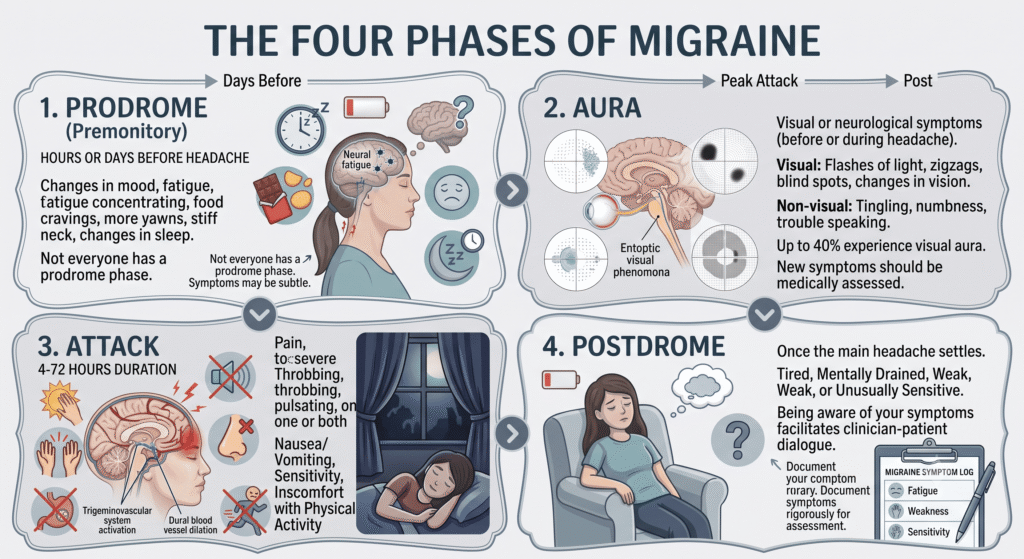
Depending on a variety of factors, an individual’s migraine attack may traverse multiple phases.
1. Prodrome
(sometimes called premonitory) Symptoms can happen hours, sometimes a day or two, before you get your headache. They might include:
- Changes in mood
- Fatigue
- Trouble concentrating
- Food cravings
- More yawns than usual
- Stiff neck: Changes in sleep
Not everyone has a prodrome phase. You might feel these symptoms without knowing what’s causing them.
Not everyone experiences this phase, and symptoms may be subtle enough to go unnoticed.
2. Aura
You’ll have migraine with aura if you experience certain neurological symptoms — such as visual ones — either before or while experiencing your headache. Visual aura affects up to 40% of people who get migraines. It usually involves flashes of light or seeing zigzags, blind spots, or some change in your field of vision. But some people experience tingling, numbness, or trouble speaking, too.
Aura isn’t always part of a migraine episode – don’t assume that’s what you’re experiencing just because you have aura, especially if you’ve never had neurological symptoms before.
New or unusual symptoms should be medically assessed.
3. Attack
This is the phase that many people associate with migraine. During this phase, you might have headaches that could range from moderate to severe, throbbing or pulsating, and possibly on one or both sides of your head.
You could also experience other symptoms, including:
• Nausea/Vomiting
• Sensitivity to Light
• Sensitivity to Sound
• Sensitivity to Smells
• Increased Discomfort during Physical Activity
Some people would rather rest in a quiet, dark room than take any chances if they know they are going through an attack as they wait for their symptoms to settle down.
4. Postdrome
Once the main headache settles, you may find yourself suffering from what’s called the ‘postdrome’ phase, where you may be feeling tired, mentally drained, weak, or unusually sensitive.
With the range of phases and symptoms that come along with migraine (not just head pain), being aware of your own symptoms will make discussions with your neurologist run much more smoothly.
Migraine vs Tension Headache: Key Differences
When comparing migraine vs headache, it is important to look beyond pain intensity. The location and character of the pain, associated symptoms, duration, and triggers can all provide useful clues.
Pain Type & Location
A tension headache commonly produces a dull, pressing, or tightening sensation affecting both sides of the head. The discomfort may feel as though a band is wrapped around the forehead or head.
Migraine pain is more commonly moderate to severe and may have a throbbing or pulsating quality. It can affect one side of the head, although migraine pain may also occur on both sides.
Pain location alone does not confirm the type of headache. Some people experience migraine without the typical one-sided pattern, which is why the overall symptom pattern matters.
Associated Symptoms
The associated symptoms are one of the important factors when considering the difference between migraine and headache.
A tension headache generally does not cause the pronounced nausea, vomiting, or neurological symptoms commonly associated with migraine. People with tension headaches may still experience some sensitivity to light or sound, but these symptoms are usually less prominent.
Migraine can involve nausea, vomiting, sensitivity to light and sound, sensitivity to smells, and worsening of pain with routine physical activity. Some people also experience aura before or during an attack.
Duration & Triggers
Both migraine and tension headaches can have different durations and triggers from person to person.
| Feature | Migraine | Tension Headache |
| Pain quality | Often throbbing or pulsating | Usually pressing or tightening |
| Typical location | Often one side, but it can be both sides | Commonly, both sides of the head |
| Pain intensity | Moderate to severe | Mild to moderate, usually |
| Nausea | Common | Usually absent |
| Light/sound sensitivity | Common | May occur, but generally less prominent |
| Aura | May occur in some people | Not typical |
| Physical activity | May make pain worse | Usually does not significantly worsen pain |
| Common triggers | Stress, hormonal changes, sleep changes, certain foods, sensory stimuli, and other individual triggers | Stress, muscle tension, poor posture, prolonged screen use, and fatigue |
| Duration | Often 4–72 hours when untreated | May last from 30 minutes to several days |
So, how is a migraine different from a headache? The key is that migraine is a neurological condition with a characteristic combination of headache and other possible symptoms, whereas a tension headache typically causes a pressure-like headache without the broader neurological features commonly seen with migraine.
It is also worth remembering that not every headache fits neatly into one category. Other primary headaches and secondary headaches can have overlapping symptoms, making professional assessment important when the pattern is persistent, changing, or unusual.
When Should You See a Neurologist?
Occasional headaches may improve with rest, hydration, regular meals, adequate sleep, and identifying personal triggers. However, recurring headaches deserve attention, particularly when they are becoming more frequent or affecting your quality of life.
Consider consulting a neurologist if:
- Your headaches are becoming more frequent or severe.
- The pattern of your usual headache suddenly changes.
- Headaches regularly interfere with work, sleep, or daily activities.
- You frequently need medication to manage headaches.
- You experience visual, sensory, speech, or other neurological symptoms.
- You are unsure whether your symptoms represent migraine, tension headache, or another condition.
Some headaches require urgent medical attention. Seek emergency care for a sudden, extremely severe headache, particularly if it reaches maximum intensity very quickly, or if a headache occurs with new weakness, confusion, fainting, seizures, significant vision changes, difficulty speaking, high fever with neck stiffness, or following a significant head injury.
A neurologist can review your symptoms, medical history, headache pattern, triggers, and associated features to determine whether further evaluation is needed. Keeping a headache diary can also help identify patterns and provide useful information during an appointment.
Get Expert Headache & Migraine Care in Dubai
For people experiencing recurring migraines, frequent headaches, or symptoms that are difficult to understand, consulting an experienced neurologist can help identify the underlying pattern and determine whether further evaluation is needed. Dr. Amit Arora is a Consultant Neurologist at Fakeeh University Hospital, Silicon Oasis, Dubai, with extensive experience in the assessment and management of neurological conditions, including headache and migraine disorders.
Dr. Amit Arora holds an MBBS, MD in Internal Medicine, and DM in Neurology, along with SCE Neurology from the Royal College of Physicians, UK, and Fellowship of the European Board of Neurology (FEBN). His specialist training includes a Clinical Epilepsy Fellowship at AIIMS, New Delhi, followed by further training at Cleveland Clinic, Ohio, in clinical epilepsy and neurophysiology.
With around 15 years of clinical experience, including 8 years of experience in the UAE, Dr. Arora has worked across a range of neurological conditions and understands the importance of assessing symptoms in the context of each patient’s medical history and individual experience.
When evaluating headaches or suspected migraine, a detailed clinical assessment can help distinguish between different headache types and identify symptoms that may require further investigation. Dr. Arora takes a patient-focused approach, listening carefully to the nature, frequency, duration, triggers, and associated symptoms of headaches before determining the appropriate next steps.
If your headaches are becoming more frequent, changing in pattern, affecting your daily activities, or occurring alongside neurological symptoms, consulting a neurologist can be an important step toward understanding your condition and receiving appropriate care.
Frequently Asked Questions
1. What is the main difference between a migraine and a tension headache?
The main difference between migraine and headache depends on the type of headache being compared. Migraine often causes moderate to severe throbbing pain along with symptoms such as nausea and sensitivity to light or sound. A tension headache usually causes mild to moderate pressing or tightening pain, often on both sides of the head, without prominent nausea or neurological symptoms.
2. Where do you feel a tension headache?
A tension headache commonly causes pressure or tightness across the forehead, temples, or around the back of the head. The discomfort can sometimes extend into the neck and shoulders. It is often felt on both sides rather than being limited to one area.
3. Can a tension headache turn into a migraine?
A tension headache does not typically transform directly into a migraine. However, a person can experience both types of headache, and their symptoms may sometimes overlap. Stress, poor sleep, and other shared triggers can contribute to different headache types in the same person.
4. How long does a migraine usually last?
A typical migraine attack can last several hours and, when untreated, may continue for up to 72 hours. The exact duration varies between individuals and from one attack to another. Some people may also experience fatigue or other symptoms after the main headache has resolved.
5. What triggers migraines vs tension headaches?
Migraine triggers vary considerably and may include stress, changes in sleep, hormonal fluctuations, skipped meals, dehydration, sensory stimuli, and individual dietary or environmental triggers. Tension headaches are commonly associated with stress, muscle tension, poor posture, prolonged screen use, fatigue, and inadequate sleep. Identifying personal patterns through a headache diary can be useful.
6. When should I see a neurologist for headaches?
You should consider seeing a neurologist if headaches are frequent, worsening, changing in pattern, interfering with daily activities, or difficult to manage. New neurological symptoms or a sudden, unusually severe headache require prompt medical assessment. A neurologist can help determine the likely cause and whether further evaluation is appropriate.