A secondary headache is a type of headache caused by an underlying medical condition, injury, infection, medication, or another identifiable factor. Unlike primary headache disorders such as migraine or tension-type headache, the headache itself is a symptom of another problem that may require medical evaluation.
The symptoms of a secondary headache can vary depending on its underlying cause. Some may develop gradually, while others can appear suddenly and severely. Recognising changes in headache pattern, associated neurological symptoms, or other warning signs can help determine when further medical assessment is needed.
What Is a Secondary Headache?
A secondary headache occurs when head pain develops as a result of another medical condition or external factor. In this situation, the headache is not the primary disorder but a symptom associated with an underlying cause.Secondary headaches can occur due to conditions affecting the brain, blood vessels, surrounding tissues, or the body more generally. Head or neck injuries, infections, medication-related problems, and certain vascular or neurological conditions can also cause secondary headaches.
Unlike primary headache disorders, identifying and treating the underlying cause is an important part of managing a secondary headache.
What Does a Secondary Headache Feel Like?
Secondary Headache Pain
The pain associated with a secondary headache can vary considerably depending on its cause. It may be described as pressure, throbbing, aching, sharp, stabbing, or severe pain. Some secondary headaches develop gradually, while others can appear suddenly and reach maximum intensity very quickly.
The location of the pain can also vary. It may affect one side of the head, both sides, the forehead, temples, back of the head, or the area around the eyes. The character and pattern of the pain alone cannot always identify its underlying cause.
Is Secondary Headache Always Severe?
No. A secondary headache is not necessarily severe. Some underlying conditions can cause mild or moderate head pain, while others may produce sudden or extremely intense headaches.
More important than pain intensity alone are changes in the usual headache pattern, sudden onset, associated neurological symptoms, or other warning signs. A new or unusual headache should therefore be evaluated in the context of the person’s overall symptoms and medical history.
Secondary Headache Symptoms
The symptoms of a secondary headache depend on the underlying condition. Common symptoms may include:
- New or unusual head pain
- Headache that changes in pattern or intensity
- Sudden, severe headache
- Persistent or progressively worsening headache
- Nausea or vomiting
- Fever or neck stiffness
- Vision changes
- Dizziness or problems with balance
- Weakness or numbness
- Difficulty speaking
- Confusion or changes in alertness
- Seizures
- Headache following a head injury
A secondary headache may occur with symptoms related to the underlying condition. For this reason, recognising associated symptoms can provide important clues during a neurological evaluation.
Secondary Headache Causes
What Causes Secondary Headaches?
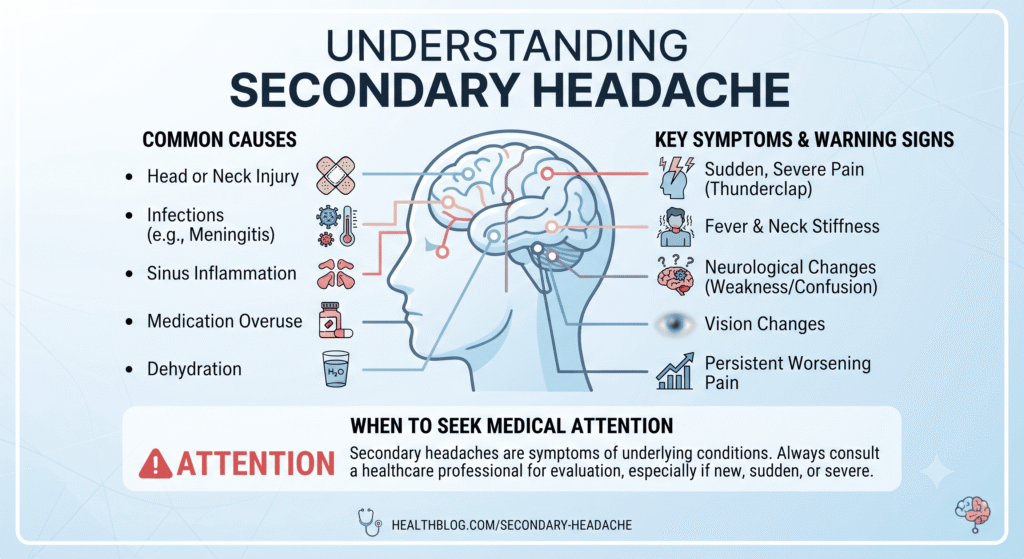
There are many possible secondary headache causes, and the underlying condition can range from relatively common problems to conditions requiring urgent medical attention.
Head or neck injuries can cause headaches, while infections affecting the sinuses, brain, or surrounding tissues may also produce head pain. Certain blood vessel conditions, bleeding around the brain, changes in pressure within the skull, and other neurological disorders can also result in a secondary headache.
Medication use, medication overuse, dehydration, and exposure to certain substances may contribute to headaches in some individuals. The specific cause needs to be assessed based on the headache pattern, symptoms, medical history, and examination findings.
Common Conditions Associated With Secondary Headaches
Conditions that may be associated with secondary headaches include:
- Head or neck injuries
- Infections such as meningitis or encephalitis
- Sinus-related infections or inflammation
- Bleeding in or around the brain
- Stroke and certain blood vessel disorders
- Cerebral venous thrombosis
- Changes in pressure within the skull
- Brain tumours or other structural conditions
- Medication-related headaches
- Medication-overuse headache
- Dehydration
- Certain toxic or environmental exposures
Having a headache does not automatically mean that a serious underlying condition is present. A neurologist considers the complete clinical picture before determining whether further investigation is necessary.
What Are the Warning Signs of a Secondary Headache?
Certain headache features may require prompt medical evaluation. Warning signs can include:
- A sudden headache that reaches maximum intensity within a short period
- A new or unusually severe headache
- Headache following a head injury
- Headache accompanied by fever or neck stiffness
- Headache with weakness, numbness, or difficulty speaking
- New vision changes
- Confusion, fainting, or changes in consciousness
- Seizures
- A headache that is progressively worsening
- A significant change in an established headache pattern
- A new headache in people with certain underlying medical conditions
A sudden, severe headache or a headache accompanied by significant neurological symptoms should not be assumed to be a routine headache and may require urgent medical assessment.
How Are Secondary Headaches Diagnosed?
There is no single test that confirms every secondary headache. Diagnosis focuses on identifying the underlying cause through the person’s medical history, headache pattern, neurological examination, and appropriate investigations.
Medical History and Symptom Pattern
A neurologist may ask about:
- When the headache started
- How quickly the pain developed
- Where the pain occurs
- The severity and character of the pain
- How long the headache lasts
- Whether headaches are recurring or persistent
- Whether the headache pattern has recently changed
- Associated symptoms such as vomiting or vision changes
- Neurological symptoms such as weakness or numbness
- Previous headaches and medical conditions
- Recent infections or injuries
- Current medications and medication use
The timing, progression, associated symptoms, and circumstances surrounding a headache can provide important clues about whether further evaluation is needed.
Treatment of Secpndary Headache
Treatment for a secondary headache depends primarily on identifying and addressing the underlying cause. Managing the head pain may be part of treatment, but treating the condition responsible for the headache is often an important component of care.
Treatment for the Underlying Cause
Once the cause has been identified, treatment may involve addressing the specific medical condition responsible for the headache.
Depending on the situation, management may include treatment for an infection, appropriate care following a head injury, management of a vascular or neurological condition, or changes to medications that may be contributing to the headache.
Because secondary headaches have different causes, treatment needs to be tailored to the individual’s diagnosis and overall health.
Managing Secondary Headache Symptoms
Alongside treatment of the underlying cause, a neurologist may recommend appropriate measures to manage headache symptoms.
This can include suitable pain management, adequate hydration when relevant, rest, and avoiding factors that may worsen symptoms. The appropriate approach depends on the underlying condition and should be determined as part of an individualised treatment plan.
Secondary Headache vs Primary Headache: What’s the Difference?
Secondary and primary headaches can both cause significant head pain, but they differ in their underlying nature.
| Feature | Secondary Headache | Primary Headache |
| Underlying cause | Caused by another medical condition or factor | The headache disorder itself is the primary condition |
| Examples | Infection, injury, bleeding, vascular conditions | Migraine, tension-type headache, cluster headache |
| Pain pattern | Can vary depending on the underlying cause | Often follows a recognisable headache pattern |
| Associated symptoms | May include symptoms related to the underlying condition | Usually follows characteristic symptoms of the headache disorder |
| Diagnosis | Focuses on identifying the underlying cause | Primarily based on headache history and clinical features |
| Treatment | Treats the underlying cause along with headache symptoms | May involve acute and preventive headache treatment |
The distinction is important because a new or significantly different headache may require evaluation to determine whether an underlying condition is responsible.
When Should You See a Neurologist for a Secondary Headache?
You should consider neurological evaluation if you experience:
- A new or unusual headache
- A sudden or extremely severe headache
- Headaches that are becoming progressively worse
- A significant change in an established headache pattern
- Headache following a head injury
- Headache accompanied by vision changes
- Weakness, numbness, or difficulty speaking
- Confusion, seizures, or loss of consciousness
- Headache accompanied by fever or neck stiffness
- Headaches that do not improve or continue to recur without a clear explanation
A new or significantly different headache should be assessed rather than assumed to be a familiar headache disorder. If a headache develops suddenly at maximum intensity or occurs with serious neurological symptoms, urgent medical evaluation may be required.
Dr. Amit Arora is a Consultant Neurologist with over 15 years of experience, including experience from the UAE. He has successfully treated and managed migraine headaches, chronic migraines, and other complicated neurological disorders.He understands the importance of the patient’s comfort and the ability to communicate effectively. In addition, he is mindful of the overall outcome of the treatment. He designs a treatment plan to meet the patient’s needs while ensuring a high standard of care, including the ethical aspects of neurology.